
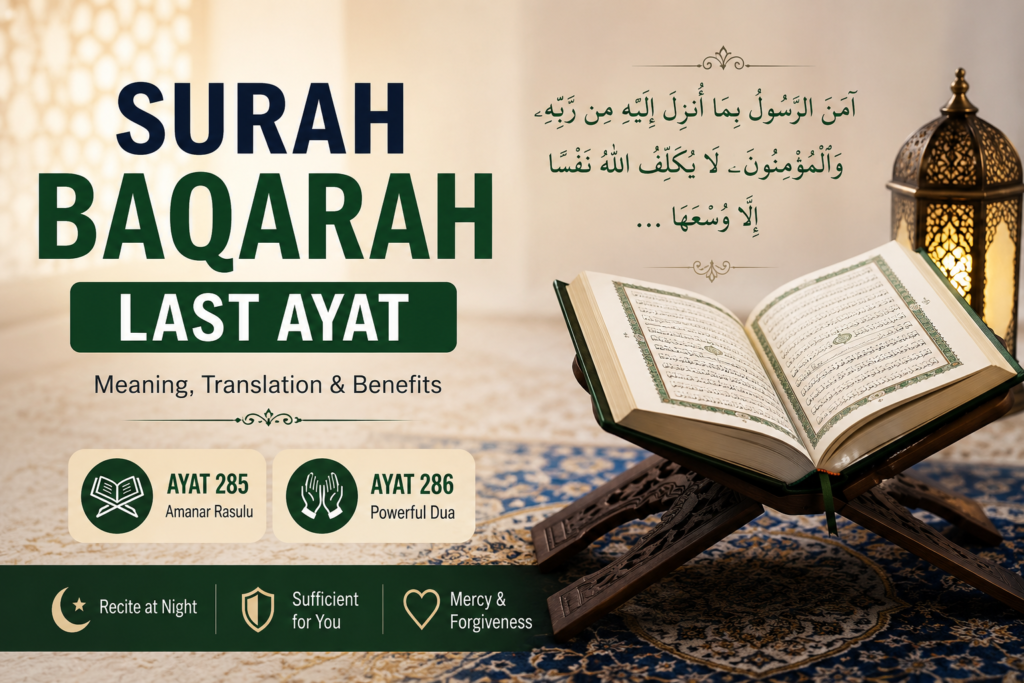
The phrase Surah Baqarah last ayat usually refers to the final two verses of Surah Al-Baqarah: Ayat 285 and 286. Some people use the phrase for Ayat 286 alone because it is the surah’s final verse.
These verses summarize faith, obedience, personal responsibility, forgiveness, mercy, and complete reliance on Allah. Prophet Muhammad ﷺ also encouraged Muslims to recite both verses at night. An authentic hadith states that whoever reads them during the night, they will be sufficient for that person.
What Are the Last Two Ayat of Surah Baqarah?
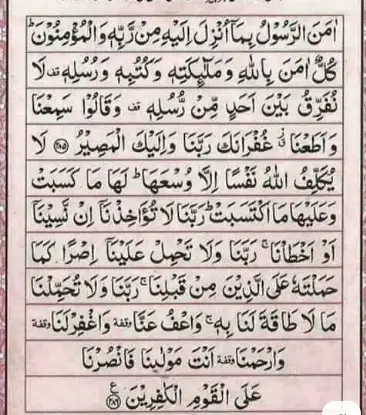
Surah Al-Baqarah is the second and longest chapter of the Quran. It contains 286 verses. Its final two verses are:
- Surah Al-Baqarah Ayat 285
- Surah Al-Baqarah Ayat 286
Ayat 285 begins with “Amanar Rasulu”, which means that the Messenger believes in what Allah revealed to him. Ayat 286 begins with “La yukallifullahu nafsan illa wus’aha,” meaning Allah does not place upon any soul more than it can bear.
Together, the verses move through three powerful themes:
- Complete faith in Allah and His revelation
- Willing obedience and repentance
- A comprehensive dua for pardon, forgiveness, mercy, and help
Surah Baqarah Ayat 285 in Arabic
آمَنَ الرَّسُولُ بِمَا أُنزِلَ إِلَيْهِ مِن رَّبِّهِ وَالْمُؤْمِنُونَ ۚ كُلٌّ آمَنَ بِاللَّهِ وَمَلَائِكَتِهِ وَكُتُبِهِ وَرُسُلِهِ لَا نُفَرِّقُ بَيْنَ أَحَدٍ مِّن رُّسُلِهِ ۚ وَقَالُوا سَمِعْنَا وَأَطَعْنَا ۖ غُفْرَانَكَ رَبَّنَا وَإِلَيْكَ الْمَصِيرُ
Surah Baqarah Ayat 285 Transliteration
Āmana ar-rasūlu bimā unzila ilayhi min rabbihi wal-mu’minūn. Kullun āmana billāhi wa malā’ikatihi wa kutubihi wa rusulih. Lā nufarriqu bayna aḥadin min rusulih. Wa qālū sami‘nā wa aṭa‘nā, ghufrānaka rabbanā wa ilayka al-maṣīr.
Surah Baqarah Ayat 285 English Meaning
The Messenger believes in what his Lord has revealed to him, and the believers also believe. They all believe in Allah, His angels, His revealed Books, and His messengers. They do not reject one messenger while accepting another.
The believers declare that they hear Allah’s command and obey it. They ask their Lord for forgiveness, knowing that everyone will ultimately return to Him.
Surah Baqarah Ayat 286 in Arabic
لَا يُكَلِّفُ اللَّهُ نَفْسًا إِلَّا وُسْعَهَا ۚ لَهَا مَا كَسَبَتْ وَعَلَيْهَا مَا اكْتَسَبَتْ ۗ رَبَّنَا لَا تُؤَاخِذْنَا إِن نَّسِينَا أَوْ أَخْطَأْنَا ۚ رَبَّنَا وَلَا تَحْمِلْ عَلَيْنَا إِصْرًا كَمَا حَمَلْتَهُ عَلَى الَّذِينَ مِن قَبْلِنَا ۚ رَبَّنَا وَلَا تُحَمِّلْنَا مَا لَا طَاقَةَ لَنَا بِهِ ۖ وَاعْفُ عَنَّا وَاغْفِرْ لَنَا وَارْحَمْنَا ۚ أَنتَ مَوْلَانَا فَانصُرْنَا عَلَى الْقَوْمِ الْكَافِرِينَ
Surah Baqarah Ayat 286 Transliteration
Lā yukallifu Allāhu nafsan illā wus‘ahā. Lahā mā kasabat wa ‘alayhā mā iktasabat. Rabbanā lā tu’ākhidhnā in nasīnā aw akhṭa’nā. Rabbanā wa lā taḥmil ‘alaynā iṣran kamā ḥamaltahu ‘alā alladhīna min qablinā. Rabbanā wa lā tuḥammilnā mā lā ṭāqata lanā bih. Wa‘fu ‘annā, waghfir lanā, warḥamnā. Anta mawlānā fanṣurnā ‘alā al-qawmi al-kāfirīn.
Surah Baqarah Ayat 286 English Meaning
Allah does not hold a person responsible for more than that person can manage. Every good deed benefits the person who performs it, while every wrong action brings consequences upon its doer.
The believers then ask Allah not to hold them accountable when they genuinely forget or make an unintentional mistake. They ask Him not to place upon them severe burdens like those placed upon earlier communities.
They continue by asking Allah not to give them trials they cannot endure. Finally, they ask Him to pardon their faults, forgive their sins, show them mercy, protect them, and grant them help against those who oppose the truth.
The Meaning of “Amanar Rasulu”
The words “Amanar Rasulu” mean “The Messenger has believed.” They begin Ayat 285 by affirming the sincere faith of Prophet Muhammad ﷺ in everything Allah revealed to him.
The verse then joins the believers with the Messenger. Genuine believers accept the foundations of faith, including belief in:
- Allah
- His angels
- His revealed Books
- All His messengers
- The return to Allah
This connection matters. Islam does not teach Muslims to accept only the prophets they prefer. Muslims believe in every messenger sent by Allah, including Adam, Nuh, Ibrahim, Musa, Isa, and Muhammad, peace be upon them all.
The verse therefore presents faith as one connected message. Different prophets received different laws for their communities, but they called people toward the worship of the one true God.
“We Hear and We Obey” as a Statement of Faith
Ayat 285 includes the declaration:
“Sami‘nā wa aṭa‘nā”
It means:
“We hear, and we obey.”
This statement describes the proper response to Allah’s guidance. A believer does not merely listen to the Quran as beautiful recitation. The believer tries to understand it, accept it, and live according to it.
Obedience does not mean that a person will never struggle. You may find certain responsibilities difficult. You may also have questions while learning. However, sincere faith means that you trust Allah’s wisdom while seeking sound knowledge.
The verse immediately follows obedience with a request for forgiveness:
“Ghufrānaka rabbanā”
This teaches balance. Believers try to obey, yet they understand their human weakness. They do not become arrogant about their worship. They ask Allah to forgive their shortcomings.
“Allah Does Not Burden a Soul Beyond Its Capacity”
The opening words of Ayat 286 are among the Quran’s most recognized statements:
“Lā yukallifu Allāhu nafsan illā wus‘ahā.”
This means that Allah does not assign a soul more than it can bear within its capacity.
The verse provides comfort, but it should be understood carefully. It does not mean that hardship will always feel easy. Some trials may feel overwhelming, painful, or exhausting. A person may cry, experience fear, need rest, or require support.
Seeking help does not contradict patience. Your ability to cope may include:
- Making dua
- Asking family members for support
- Consulting knowledgeable scholars
- Receiving professional medical or mental health care
- Taking lawful steps to leave a harmful situation
- Resting while continuing to trust Allah
The verse does not tell people to ignore suffering. Instead, it reminds them that Allah understands their limits perfectly. He knows their visible struggles and the burdens hidden inside their hearts.
Personal Responsibility in Ayat 286
The next part teaches personal responsibility:
“For it is what it has earned, and against it is what it has acquired.”
Your sincere worship, charity, patience, honesty, and kindness benefit you. Likewise, deliberate wrongdoing carries consequences.
This principle prevents two harmful attitudes.
First, it prevents hopelessness. A good deed is never meaningless before Allah, even when nobody else notices it.
Second, it prevents blame shifting. Each person must examine their own choices instead of constantly holding others responsible for their behavior.
Islam combines personal accountability with divine mercy. You are responsible for your actions, but the door of repentance remains open.
A Complete Dua Inside the Final Verse
The second half of Ayat 286 is a remarkable Quranic supplication. It teaches believers exactly what to ask from Allah.
“Do Not Hold Us Accountable If We Forget or Make a Mistake”
Human beings forget, misunderstand, and make unintentional errors. The verse teaches you to admit that weakness instead of pretending to be perfect.
A report in Sahih Muslim describes Allah’s acceptance of these requests. When the believers asked not to be held accountable for genuine forgetfulness or error, Allah responded that He had granted the request.
This does not excuse deliberate wrongdoing. A person should not knowingly disobey Allah and then label the action a mistake. The dua concerns genuine forgetfulness and unintended error.
“Do Not Place Upon Us a Burden Like Those Before Us”
The believers ask Allah for ease in religious responsibility. Earlier communities sometimes faced severe obligations and consequences.
This request helps you recognize that religious guidance is a mercy. Worship requires commitment, but Allah does not command you simply to cause unnecessary hardship.
“Do Not Burden Us With What We Cannot Bear”
This is a request for protection from unbearable trials. It also teaches humility. Believers do not ask for suffering to prove their strength. They ask Allah for well-being, gentleness, and support.
You may ask Allah to remove a trial while still remaining patient. Patience does not mean that you must desire pain.
“Pardon Us, Forgive Us, and Have Mercy on Us”
The verse contains three connected requests:
Pardon us: Ask Allah to overlook and erase your faults.
Forgive us: Ask Him to protect you from the consequences of your sins.
Have mercy on us: Ask for His care, kindness, guidance, and favor.
These words cover the past, present, and future. You need pardon for your failures, forgiveness for your sins, and mercy for every step ahead.
“You Are Our Protector”
The dua ends by recognizing Allah as the believers’ true Guardian and Protector.
A believer uses lawful means, seeks assistance, and works responsibly. However, the heart ultimately depends upon Allah rather than the means themselves.
Authentic Benefits of the Last Two Ayat of Surah Baqarah
The final two verses carry great spiritual value. However, their benefits should be described through reliable Islamic evidence rather than exaggerated promises.
They Are Sufficient for the Person Who Recites Them at Night
Prophet Muhammad ﷺ said that the person who recites the last two verses of Surah Al-Baqarah at night will find them sufficient for that night. This narration appears in both Sahih Al-Bukhari and Sahih Muslim.
The hadith does not define the word “sufficient” in one narrow way. Scholars have discussed several possible meanings, such as sufficiency in reward, remembrance, protection, or voluntary night worship.
The safest approach is to accept the Prophet’s promise without turning it into claims he did not make.
They Were Described as Part of Two Special Lights
An authentic narration describes Surah Al-Fatihah and the concluding verses of Surah Al-Baqarah as two special lights given to Prophet Muhammad ﷺ. The narration also speaks of reward connected with reciting them.
This gives Muslims another reason to value, memorize, and reflect upon the verses.
They Contain an Accepted Supplication
Ayat 286 is not merely a description of faith. It is a dua taught through revelation.
Sahih Muslim reports Allah’s acceptance of the believers’ requests for relief from accountability for genuine mistakes, severe burdens, and matters beyond their strength.
They Renew the Foundations of Faith
Ayat 285 reminds you of the central beliefs of Islam. Regular recitation can help you review those beliefs and strengthen your commitment to them.
The verse is a compact declaration of iman. It connects belief, obedience, repentance, and preparation for the Hereafter.
They Teach Hope Without Removing Responsibility
Ayat 286 offers hope through Allah’s mercy. At the same time, it teaches that each soul receives the results of what it earns.
This balance protects a person from two extremes:
- Despairing of Allah’s mercy
- Becoming careless about personal behavior
A healthy spiritual life needs both hope and accountability.
They Provide Words for Difficult Moments
During stress, grief, uncertainty, or fear, people may struggle to find the right words. Ayat 286 gives you a complete dua.
You can ask Allah for:
- Protection from unbearable hardship
- Forgiveness for your mistakes
- Mercy in your weakness
- Help against oppression
- Strength to remain faithful
Recitation may bring spiritual comfort, but it should not replace practical help when that help is needed.
When Should You Recite the Last Two Verses?
The authentic hadith specifically encourages reciting them at night. Islam does not require one exact minute for this practice.
Many Muslims recite them:
- After Isha prayer
- During evening remembrance
- Before going to sleep
- During voluntary night prayer
- When reviewing memorized Quran at night
Choose a time you can maintain consistently. A simple daily habit is often better than an ambitious routine that quickly disappears.
You may also recite the verses during the day. The nighttime recommendation does not prohibit reciting them at other times.
How Many Times Should You Read Them?
The authentic nighttime narration mentions reciting the two verses. It does not require repeating them a specific number of times.
Reading them once with sincerity fulfills the basic wording of the hadith. You may repeat them for memorization, reflection, or Quran study, but you should not present an invented number as a required religious practice.
Avoid claims such as:
- Read them exactly seven times for guaranteed wealth
- Read them a fixed number for immediate marriage
- Repeat them to guarantee success in an exam
- Recite them to cure every illness without treatment
Allah can answer any dua and provide help in extraordinary ways. However, religious promises need evidence. A Muslim should not attach guaranteed worldly outcomes to a recitation without an authentic source.
How to Memorize Surah Baqarah’s Last Two Ayat
The verses may appear long at first, especially Ayat 286. Breaking them into meaningful sections makes memorization easier.
Listen to a Clear Recitation
Choose a skilled reciter with slow and accurate pronunciation. Listen to the same recording repeatedly rather than switching between many recitation styles.
Memorize One Phrase at a Time
Divide Ayat 285 into sections such as:
- Āmana ar-rasūlu
- Kullun āmana billāh
- Lā nufarriqu bayna aḥadin min rusulih
- Sami‘nā wa aṭa‘nā
- Ghufrānaka rabbanā
Do the same with Ayat 286. Learn one phrase, repeat it, and then connect it to the next phrase.
Learn the Meaning
Meaning supports memory. When you understand the movement of the verse, the phrases become easier to recall.
Ayat 285 moves from faith to obedience and forgiveness. Ayat 286 moves from responsibility to a series of requests.
Recite Them in Prayer
Once you can recite them correctly, use them in voluntary prayers. This adds regular practice and helps move the verses into long-term memory.
Review Every Day
New memorization fades quickly without review. Read the verses daily, even after you believe you know them well.
Learn With a Qualified Quran Teacher
Transliteration can help beginners, but it cannot fully represent Arabic pronunciation. A trained teacher can correct letter sounds, elongations, stopping points, and Tajweed mistakes before they become habits.
Common Recitation and Understanding Mistakes
Reading Only From Transliteration
English letters cannot reproduce every Arabic sound accurately. Use transliteration as temporary support, not as a permanent replacement for learning the Arabic text.
Rushing Through the Verses
Fast recitation may cause missing letters, shortened vowels, or incorrect word endings. Slow down and pronounce each phrase clearly.
Ignoring the Meaning
The verses deserve more than mechanical repetition. Understanding them makes your recitation more sincere and useful.
Treating the Verses Like a Magical Formula
Quranic recitation is worship, remembrance, guidance, and a means of seeking Allah’s help. It should not be reduced to a superstition or a guaranteed formula for material results.
Using the Verse to Dismiss Someone’s Pain
Telling a suffering person, “Allah does not burden a soul beyond its capacity,” can sound harsh when offered without compassion.
Listen first. Support the person. Help them find appropriate care. Then share the verse gently as a source of hope rather than a reason to minimize their struggle.
Confusing the Last Verse With the Last Two Verses
Ayat 286 is the final verse, but the well-known nighttime hadith refers to both Ayat 285 and 286. When people search for the Surah Baqarah last ayat, they may be looking for either Ayat 286 alone or the final pair.
Practical Lessons You Can Apply Every Day
The last two ayat are not only for nighttime recitation. Their teachings can shape your daily choices.
Renew your belief: Remind yourself that faith includes accepting Allah, His angels, His Books, and all His messengers.
Practice responsive obedience: When you learn an authentic Islamic teaching, ask how you can apply it.
Seek forgiveness often: Obedience should make you humble, not proud.
Take responsibility: Focus on what you can correct in your own behavior.
Ask Allah for ease: You do not need to pretend that hardship is painless.
Use available support: Depending on Allah includes using lawful resources He has placed around you.
Show compassion: Never use religious words to silence someone who needs help.
Balance fear and hope: Remember accountability, but never lose hope in Allah’s pardon and mercy.
Frequently Asked Questions
What is the Surah Baqarah last ayat?
The final ayat of Surah Al-Baqarah is Ayat 286. However, people commonly use this phrase when referring to the last two verses, Ayat 285 and 286.
What are the last two verses of Surah Baqarah called?
They are often called Amanar Rasulu, based on the opening words of Ayat 285. They may also be called the concluding verses of Surah Al-Baqarah.
What is the main message of Ayat 285?
Ayat 285 affirms belief in Allah, His angels, His Books, and all His messengers. It also teaches obedience, repentance, and preparation for the return to Allah.
What is the main message of Ayat 286?
Ayat 286 teaches that Allah understands every person’s capacity. It combines accountability with a dua for pardon, forgiveness, mercy, relief, and divine help.
What is the benefit of reading the last two ayat at night?
An authentic hadith states that they will be sufficient for the person who recites them at night. The exact scope of that sufficiency is not narrowly defined in the narration.
Should I read them before sleeping?
You may read them before sleeping, after Isha, or at another point during the night. No single nighttime minute is required by the authentic hadith.
How many times should I recite the verses?
The authentic narration does not set a required repetition count. Reciting both verses once at night follows the basic wording of the hadith.
Can I read only Ayat 286?
Yes, you may recite Ayat 286 by itself. However, the specific nighttime hadith mentions the final two verses together.
Can the last two verses guarantee protection from every problem?
The hadith promises that they will suffice the nighttime reciter, but it does not support every popular claim made online. Recite them with faith while continuing to take responsible and lawful action.
How can I pronounce the verses correctly?
Listen to a reliable reciter and study with a qualified Quran teacher. Transliteration can help you begin, but direct correction is the best way to improve Arabic pronunciation and Tajweed.
Conclusion
The Surah Baqarah last ayat brings together the essential foundations of a believer’s life. Ayat 285 teaches faith, acceptance, obedience, and repentance. Ayat 286 teaches responsibility, hope, forgiveness, mercy, and dependence upon Allah.
These verses do not promise a life without hardship. They teach you how to face hardship without losing faith. They remind you that Allah knows your capacity, sees your effort, accepts sincere prayer, and remains your true Protector.
Make the final two verses part of your nighttime routine. Read them slowly, learn their meaning, correct your pronunciation, and carry their message into your daily life. The goal is not only to memorize their words. It is to become a person who can sincerely say:
“We hear, and we obey. We seek Your forgiveness, our Lord, and to You is the final return.”